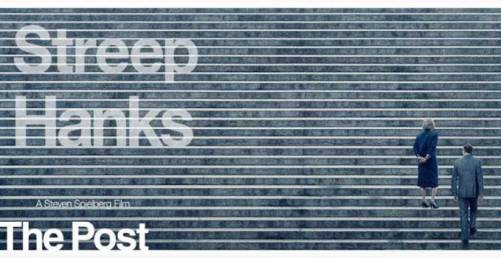
The Post

the post.jpg

Director: Steven Spielberg
Writer: Liz Hannah, Josh Singer
Released: December 2017
Starring: Meryl Streep, Tom Hanks, Sarah Paulson, Bob Odenkirk, Tracy Letts, Bradley Whitford, Bruce Greenwood, Matthew Rhys

The Post comes across as a film with similar emotional impact to the likes of Spotlight (a highly recommended investigative journalism movie), but it sorely missed the mark.

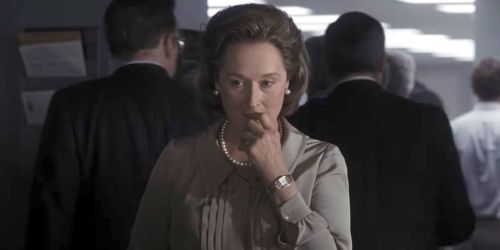
It follows the real-life story of the Washington Post in the 1960s, a paper passed down to  Katharine Graham (Meryl Streep) who is struggling to keep the company financially afloat. Then, a big story breaks as government secrets relating to the Vietnam war are leaked – this massive story could make or break the paper.

But with the New York Times already being threatened with legal action for publishing only part of the information now available, Katherine is reluctant to allow editor-in-chief  Ben Bradlee (Tom Hanks) to publish the story for fear of bankrupting the paper. Meanwhile, she is fighting the emotional turmoil of being a woman in a man’s world.
the post2.jpg

The movie opens with a scene of the Vietnam war, which was definitely not required and I believe it was only included to pay homage to Stephen Spielberg’s Saving Private Ryan success. So that kicked this film off poorly.

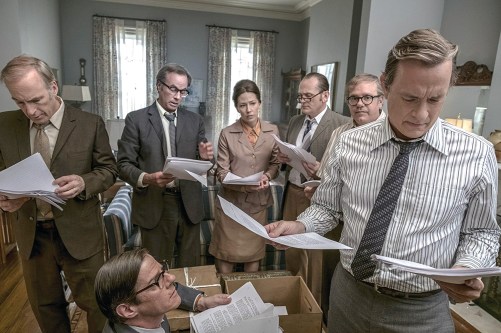
Then it was about an hour of long, dry dialogue, which I struggled to pay attention to. So I’m not entirely sure if they explained what the government secrets were specifically, but I’m pretty sure the gist was that the government knew the US would lose the war but continued to send troops for fear of being embarrassed. But I don’t see how that could have taken an hour to explain… Maybe I missed something.
the post3.jpg

The second half of the film focussed on gender inequality and women’s rights as it follows Katherine, who slowly becomes more self-confident as she learned the ropes of running the paper after her husband’s death. She is spoken down to by colleagues, which makes the decision of publishing the leaked information or not even more difficult to make.

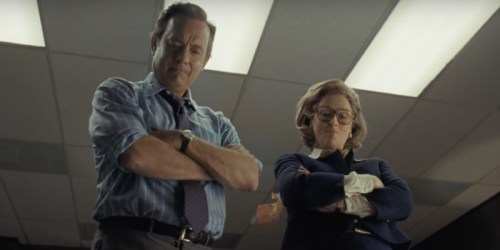
The cast was great of course. Meryl Streep is amazing and Tom Hanks is his usual great self, but did come across as more ‘family man’ than ‘tough editor’. I do wonder if Bryan Cranston was considered for this role due to the amount of Breaking Bad actors featured (Bob Odenkirk and Jesse Plemons). I think his darker domineer would have come across well.
the post4.jpg

Overall, the exciting, fast-paced and emotionally-charged storyline that I was expecting was not there. Just a ton of unnecessary dialogue and a story that didn’t portray the risk and stress of the situation very well.

Oh well. Perhaps it needs a second viewing.

Jodie’s rating: 5/10

Saving Mr. Banks

saving mr banks.jpg

Welcome to the 400th post! It’s taken six years and four months to get here.

Director: John Lee Hancock
Writer: Kelly Marcel, Sue Smith
Released: November 2013
Starring: Emma Thompson, Tom Hanks, Paul Giamatti, Jason Schwartzman, Bradley Whitford, Colin Farrell

I think Saving Mr. Banks is a brilliant take on the Mary Poppins story. It’s not a remake or a sequel, it’s more of the ‘behind the scenes’ of the classic Mary Poppins story. It’s the story behind the story.

It follows Pamela Travers (Emma Thompson) who is approached by Walt Disney (Tom Hanks) himself regarding her children’s book series, Mary Poppins.

Walt Disney: Look at you! I could eat you up!
P.L. Travers: That wouldn’t be appropriate.

saving mr banks3.jpg

While we follow her reluctancy to give up the copyright, her guard is ever so slowly lowered as we begin to find out the root of her Poppins stories. They are in fact based on a lady who comes to look after young Travers and her siblings while her dad, ‘Mr. Banks’ (Colin Farrell) suffers alcoholism and slowly dies.

saving mr banks2.jpg

It comes to be that the Mary Poppins character in Travers’s childhood is a woman who isn’t there to save her or her siblings, but is there to try and save her beloved father. Hence why Travers is so reluctant to have her stories meddled with; she’s still coming to terms with the guilt.

Walt Disney: “No whimsy or sentiment!” says the woman who sends a flying nanny with a talking umbrella to save the children.
P.L. Travers: You think Mary Poppins is saving the children, Mr. Disney?
[Walt and the other filmmakers are stunned silent]
P.L. Travers: Oh, dear!

saving mr banks4.jpg

Throughout the melancholy scenes are the uplifting songs that Walt Disney’s composers are developing. The music that we associate with the 1964 Mary Poppins musical is reused to support Travers’s journey of trusting Walt Disney and their rocky working relationship.

Richard Sherman: Room here for everyone / Gather around / The constable’s “responstible!” / Now how does that sound?
P.L. Travers: No, no, no, no, no! “Responstible” is not a word!
Richard Sherman: We made it up.
P.L. Travers: Well, un-make it up.

Saving Mr Banks is an incredible story that simultaneously warms and breaks your heart. I was crying my eyes out through much of this film, especially the ‘let’s go fly a kite’ scene, holy Jesus. It brings a whole new meaning and depth to the Mary Poppins we have come to know.

Tom Hanks was the perfect choice to play Walt Disney. They both have an optimistic persona, while being untouchable American treasures.

I love this ‘prequel’ of sorts to the Julie Andrews musical. It’s entertaining and insightful, although perhaps a little dry in places, and a little too heavy in others.

Jodie’s rating: 6/10