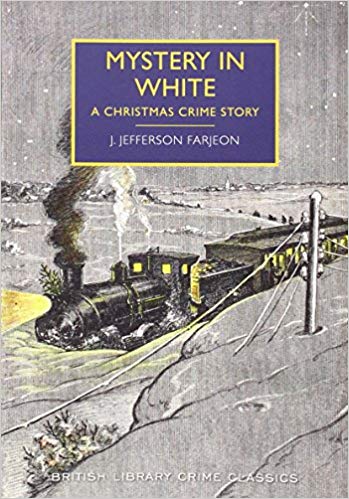
Mystery in White – J. Jefferson Farjeon

mystery in white.jpg

Writer: J. Jefferson Farjeon
Genre: Murder mystery/crime thriller
Released: 1937
Blurb: On Christmas Eve, heavy snowfall brings a train to a halt near the village of Hemmersby. Several passengers take shelter in a deserted country house, where the fire has been lit and the table laid for tea – but no one is at home. Trapped together for Christmas, the passengers are seeking to unravel the secrets of the empty house when a murderer strikes in their midst. 

This was one of the first murder-mystery novels I had read, and it got me hooked on the genre.

I think it was after having read an Agatha Christie Miss Marple novel that I decided to investigate the genre further online, and this book came up. I’m not even sure why or how.

Nevertheless, despite it being a book written in the thirties, it was so well written. It was impeccably easy to read, which made it so gripping.

I probably should have told you about this book before Christmas since it is set on the night of Christmas Eve. But never mind!

It’s about a train that gets stuck in an unexpected snow storm. A group of passengers decide to try and walk through the snow to reach a nearby town, but end up taking refuge in an empty house.

What’s strange about it is that the fire is on, the table is laid and a knife has been left out. There are locked rooms and strange occurrences. Then murder strikes!

Storylines intertwine and different character perspectives show the crime from different angles. I loved every page of it! You get so lost in the mystery of it all, and best of all, the ending is brilliant.

The characters are all from different backgrounds with strong personalities – including a chorus girl, an elderly bore and a psychic.

It did get a bit messy within the final chapters, but I’m hoping I interpreted correctly.

A fabulous read! I still think about it often.

Jodie’s rating: 7/10

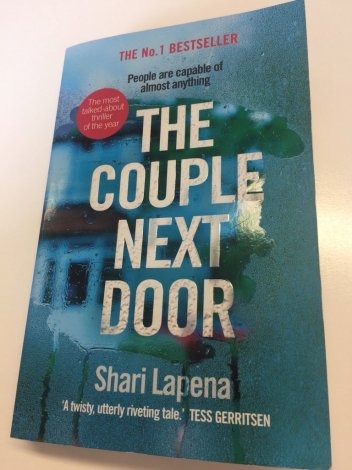
The Couple Next Door – Shari Lapena

thecouplenextdoor.jpeg

Writer: Shari Lapena
Genre: Mystery/crime
Released: 2017
Blurb: You never know what’s happening on the other side of the wall. Your neighbour told you that she didn’t want your six-month-old daughter at the dinner party. Nothing personal, she just couldn’t stand her crying. Your husband said it would be fine. After all, you only live next door. You’ll have the baby monitor and you’ll take it in turns to go back every half hour. Your daughter was sleeping when you checked on her last. But now, as you race up the stairs in your deathly quiet house, your worst fears are realized. She’s gone.


I’ve heard this book is considered to be the next best thriller since The Girl on the Train. While it is most certainly a page-turner (I don’t think I’ve ever read a novel this quickly before), I don’t think the storyline or mystery is on par with The Girl on the Train.

Of course, the money’s in the bag within the first couple of chapters. Playing on everyone’s worst fear of having their child go missing is a gripping basis for a novel. But there were a few major flaws to this story that meant that what began as a brilliantly horrifying story soon turns into an un-mysterious tale.

The main reason for this is Detective Rasbach, who is investigating how Anne and Marco Contis’ baby was kidnapped. While it’s good to have a wise and experienced person in charge, like a Miss Marple/Hercule Poirot kind of character, it is not ideal to have a character who is always right. Regretfully his ‘suspicions’ are always proved to be correct within a couple of chapters, giving the game away too early before every twist and turn.

We shouldn’t be inside Rasbach’s head as frequently because his thoughts reveal the mysteries prematurely. It’s like watching a horror film with someone who commentates it: ‘I bet they die’ or ‘I bet there will be an explosion’, then having them promptly proved correct every time. It spoils the surprises.

Secondly, the entire backstory of Anne is rendered unnecessary and useless. I don’t want to give anything away, but her issues are irrelevant and the conclusion to her part of the story wasn’t needed. Yes, it was twisted and scary, but it didn’t actually have anything to do with the main storyline.

While the story is more crime than mystery, it is a novel that will hook you in from the very first page, which I loved.

Ditch the idea of it being an Agatha Christie mystery, and think about it more as a twisted Gillian Flynn-inspired tale about desperate characters risking it all. Appreciate The Couple Next Door for Lapena’s writing technique, brilliant construction of the story and emotional development. But don’t expect much from the storyline itself (thanks to a certain character giving it away all the time).

Jodie’s rating: 5/10

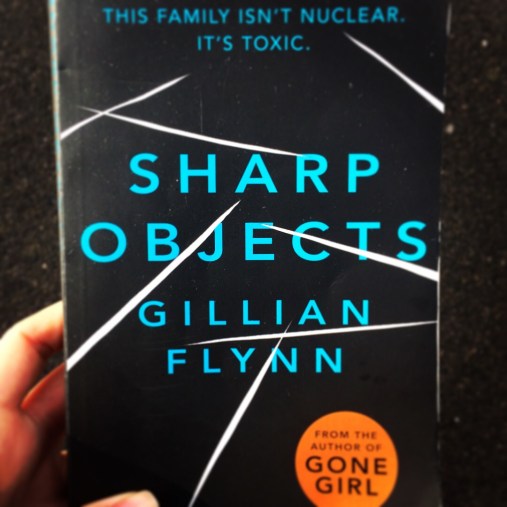
Sharp Objects – Gillian Flynn

Sharp Objects book by Gillian Flynn

Writer: Gillian Flynn
Genre: Mystery/crime
Released: 2006
Blurb: When two girls are abducted and killed in Missouri, journalist Camille Preaker is sent back to her home town to report on the crimes. Long-haunted by a childhood tragedy and estranged from her mother for years, Camille suddenly finds herself installed once again in her family’s mansion, reacquainting herself with her distant mother and the half-sister she barely knows – a precocious 13-year-old who holds a disquieting grip on the town. As Camille works to uncover the truth about these violent crimes. Dogged by her own demons, Camille will have to confront what happened to her years before if she wants to survive this homecoming.

Gillian Flynn’s first novel, Sharp Objects, is a medley of haunting and distressing themes, which frequently give-way to Flynn’s budding talent for telling crime stories.

Like many first-time authors, Flynn draws on a subject she knows about for her first novel; journalism. The main character, Camille, goes back to her creepy hometown to cover the story of preteen murders. Camille also has to confront her over-bearing mother and manic half-sister, all the while, battling with self-harm.

Not going to lie, for the most part, Sharp Objects is sadistically dark for no good reason. It’s more of a horror story about mentally-ill characters, rather than a cleverly-told mystery.

It’s clear Sharp Objects is Flynn’s debut novel, as her tone seems to be in development; it’s slower in pace and is a bit more padded out. It feels like Flynn is trying to be a bit too smart, which makes the crime seem more layered than it really is.

But, her quirky descriptions of characters are featured, which I love. Particularly regarding Camille’s step-father, Alan:

Now he sat, needly legs jutting out of white safari shorts, with a baby blue sweater draped over a crisp oxford. He sweated not at all. Alan is the opposite of moist.

Very rarely did Alan and I talk outside of my mother’s presence. As a child, I’d once bumped into him in the hallway, and he’d bent down stiffly, to eye level, and said, “Hello, I hope you’re well.” We’d been living in the same house for more than five years, and that’s all he could come up with. “Yes, thank you,” was all I could give in return.

It seems like this novel was a great starting point for Gillian Flynn to develop her style of writing, and a place to kickstart her career as an author. However, it certainly isn’t her best work, and not my favourite of hers.

It’s simply too sadistic for no good reason, whereas her novels later on down the line – Dark Places and Gone Girl – are both genius, mysterious thrillers that are brilliantly told. They’re more thought-provoking and complex.

Everyone has to start somewhere though! Flynn’s novels get better and better.

Keep an eye-out for the TV series that is to be released soon, based on Sharp Objects. The director of the series Big Little Lies is behind it!

Jodie’s rating: 5/10

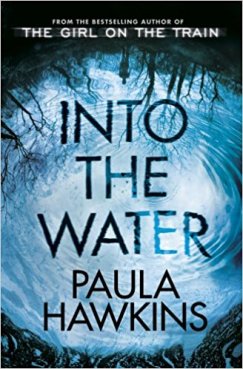
Into the Water – Paula Hawkins

into the water book review

Writer: Paula Hawkins
Genre: Thriller
Released: 2017
Blurb: Just days before her sister plunged to her death, Jules ignored her call. Now Nel is dead. They say she jumped. And Jules must return to her sister’s house to care for her daughter, and to face the mystery of Nel’s death. But Jules is afraid. Of her long-buried memories, of the old Mill House, of this small town that is drowning in secrecy . . . And of knowing that Nel would never have jumped.

Firstly, I will save the suspense and answer your call; ‘no’, it’s not as good as Girl on the TrainNevertheless, it is a fantastic book in its own right. Keeping Paula Hawkins’s style of short chapters from different characters’ points of view, you’ll find your self on the final chapter without even realising it.

Into the Water is a compelling and moody ‘who done it’ tale about the most recent death at a particular spot in a river known as the ‘drowning pool’ within the town of Beckford. The drowning pool is where suspected witches were drowned years ago, but the haunting tales and myths of the area are oppressive and obsessed upon by many.

“Beckford is not a suicide spot. Beckford is a place to get rid of troublesome women.”

Beckford is where many residence are said to be descendants of witches, and the river is as much a character as anyone. It courses like veins through the town, connecting all the characters as it weaves itself through their lives.

“Some say the women left something of themselves in the water; some say it retains some of their power, for ever since then it has drawn to its shores the unlucky, the desperate, the unhappy, the lost. They come here to swim with their sisters.”

We follow the story of Jules mostly, whose dark childhood of growing up by the river is reflected upon. She has had to return to the town because her estranged sister, Nel, is dead. Nel was researching and writing about the drownings in the river until she became the most recent victim. Was she murdered? Did she commit suicide like all the women she wrote about? Or was it something even more mysterious?

“You were never the princess, you were never the passive beauty waiting for a prince, you were something else. You sided with darkness, with the wicked stepmother, the bad fairy, the witch.”

This was a page turner in the same fashion that Girl on the Train was, with the same gritty, dark and moody themes. But unfortunately, like a Scooby Doo cartoon, the fear surrounding the almost supernatural river that claims lives in a trance-like way is soon unmasked to show nothing more than a body of water surrounded by superstition.

Into The Water is less about witches and curses and unexplained deaths, and more about female victims becoming strong, and male villains getting their just deserts. Which, was disappointing for me.

“No one liked to think about the fact that the water in that river was infected with the blood and bile of persecuted women, unhappy women; they drank it every day.”

Nevertheless, there are a couple of twists in there, with one twist being the final line on the final page. (So don’t rush through the ending.)

If you enjoyed Girl on the Train, I still think Into the Water is worth a read. I praise Hawkins’s style of writing, which makes for addictive reading. It’s absolutely brilliant.

Jodie’s rating: 6/10


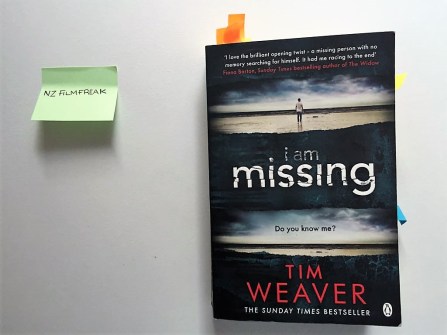
I Am Missing – Tim Weaver

Tim Weaver book I Am Missing

Writer: Tim Weaver
Genre: Crime thriller
Released: 2017
Blurb: When a young man wakes up bruised, beaten and with no memory of who he is or where he came from, the press immediately dub him ‘The Lost Man’. Ten months later, Richard Kite – if that is even his real name – remains as desperate as ever. Despite appeals and the efforts of the police, no one knows this man. Kite’s last hope may be private investigator David Raker – a seasoned locator of missing people. But Raker has more questions than answers.
Who is Richard Kite?
Why does no one know him?
And what links him to the body of a woman found beside a London railway line two years ago?

*I have tried my best not to include any spoilers in this review*

Within five days of reading it whenever I could steal an hour or two, I finished I Am Missing. I breathed a massive sigh of relief; I had been carrying a heavy burden over the last five days. I lived and breathed this story, and I felt as though I had experienced this mystery first-hand. Needless to say, I’m feeling emotionally exhausted now (in a good way).

As the story is written in first-person (rather effectively too), I felt like I was walking in the protagonist David Raker’s shoes. After Raker meets the man without any memory, ‘Richard Kite’, I felt like I had reached a dead-end along with Raker – despite only being five chapters in. It’s a missing person’s case where the missing person is standing right in front of him… Where on earth do you start to figure out who he is and where he’s come from?

“I started to wonder for the first time whether taking this case may have been a mistake.” -Investigator David Raker, chapter 5

Believe me, Raker, I was too. I was scratching my head thinking, ‘how the hell are we going to get to the bottom of where this Richard Kite fellow has come from?’. I felt genuinely anxious and concerned, my eyes drifted away from the book as I bit my lip worriedly, trying to think what to do…

Before reminding myself that I am, in fact, not a private investigator called David Raker, and I am merely sitting on a couch reading a fictional book.

Idiot.

This book does suck you right in, though. I had no awareness of my surroundings when I was reading I Am Missing. An hour became three, and at the end of every chapter phrases such as ‘no way’, ‘shut-up’, ‘holy Jesus Christ’, ‘get out of town’, ‘he did not just do that…’ were muttered as I sat in shock and suspense.

This book was particularly poignant for me because it is partly based in the Dorset/Devon area, which is where I live! I love reading about stories based so close to home.

Style of writing
Being a massive fan of Agatha Christie’s murder-mysteries, I knew I would enjoy Tim Weaver’s crime-thriller from the first page. But it was Weaver’s style of writing that hooked me in before the story itself did; it’s the author’s ability to write an exciting story in an easy-to-read fashion. Perhaps it’s his journalistic background that has influenced his style.

Don’t get me wrong: that is not a reflection of simple or amateur writing by any means. Rather an enviable skill of creating complex and exciting scenes without confusing or losing the reader along the way.

I loved how short the chapters were; it’s such a sense of accomplishment. (This 516-page novel is divided into 81 chapters, which is an average of 6.4 pages per chapter.) But what’s genius about it, is how there is a cliffhanger at the end of every chapter! I really struggled to keep my heart rate down, particularly the few chapters about the ‘The Monster’.

It was about a hundred feet away, on the fringes of the torchlight…Whatever it was, it was following them, crouched slightly, the arch of its back, its arms, visible above the apex of the grass… –The Monster

I read this part on the train, and I can’t imagine what my expression looked like when the guard interrupted my engrossed reading to check my ticket.

The only passages in his book that I found jarring were a few bits of dialogue from a young character called Beth. Maybe Weaver isn’t too familiar with how young teenage girls talk to each other? I would have swapped a few words, and written the dialogue a bit differently. But perhaps that’s simply because I was a teenage girl once. Nevertheless, it didn’t detriment the story in any way.

How I wish I could write a well-articulated story. I kept thinking about Kristen Wiig’s character in Walter Mitty who spoke about how to write a mystery book:

“Connect the clues, and then scatter them so they seem unrelated” – Cheryl, The Secret Life of Walter Mitty

Although, in my attempts at writing a novel, it certainly isn’t as easy as Cheryl makes it seem!

Characters
Although there was no character in particular I could strongly identify with or whom I looked forward to reading about, the characters certainly all had a strong sense of identity. Perhaps I didn’t resonate with the characters as much as I have with other books because I tend to read books about a female character’s internal, emotional struggle rather than external, environmental problems that Raker experienced in this book.

I did, however, enjoy that the protagonist was not a cold-hearted killing machine, which I’ve found tends to be the case in crime and action books. The emotions of this character surprised me, as he endured remorse, regret and a reflection of what his conscience would be battling with afterward. I liked that about him the most; he’s a forward-thinking empathetic person.

“I pushed the guilt down, burying it with all the grief I’d tried to suppress over the years, the regrets, the fear…” –Raker, chapter 62

There were mini summaries at the end of most chapters, whereby Raker would go over all the notes he had just taken and all the remaining questions yet to be answered, which was massively helpful for the reader.

I also liked how, even in a situation of panic and where a decision had to be made quickly, Weaver would write out the decision-making process of the protagonist. Surprisingly, this didn’t take away from the urgency of the situation either – it heightened the intensity if anything.

“A moment of hesitation halted me, gluing me to the carpet. Take it, and he’d know for sure that someone had broken in. Don’t, and I might never know the truth. In a split second, I thought about the consequences of taking it – stealing it…” –David Raker’s decision-making, chapter 31

Overall
In Weaver’s story, I was absolutely taken into another world where I studied what every character said and did. I wasn’t just reading, I felt like I was actively taking part in solving the mystery. As cheesy and lame as that sounds… I just mean that my suspension of disbelief never wavered.

I Am Missing is a tense read, but I strongly recommend it. I know it’s a cliche, but you seriously won’t be able to put it down. I read it on the train, over dinner, on the toilet, in the bath, at work while pretending to listen to angry customers over the phone, before breakfast… Seriously. At the end of every chapter, your stomach will drop and you’ll be fighting nervous sweats.

There aren’t any lulls or ‘fluffy’ chapters, just a lot of mystery and questions that ever so slowly get answered – but probably not with the answers you’d expect.

Jodie’s rating: 8/10

PS. Note to publisher: On page 248, 11 lines from the bottom, there is an error where the word ‘were’ has been repeated. ‘So what were they were doing together?’ #hireme #wannabeproofreader